

Opens in a new tab. Your article title and link are shared only with the AI assistant you choose.
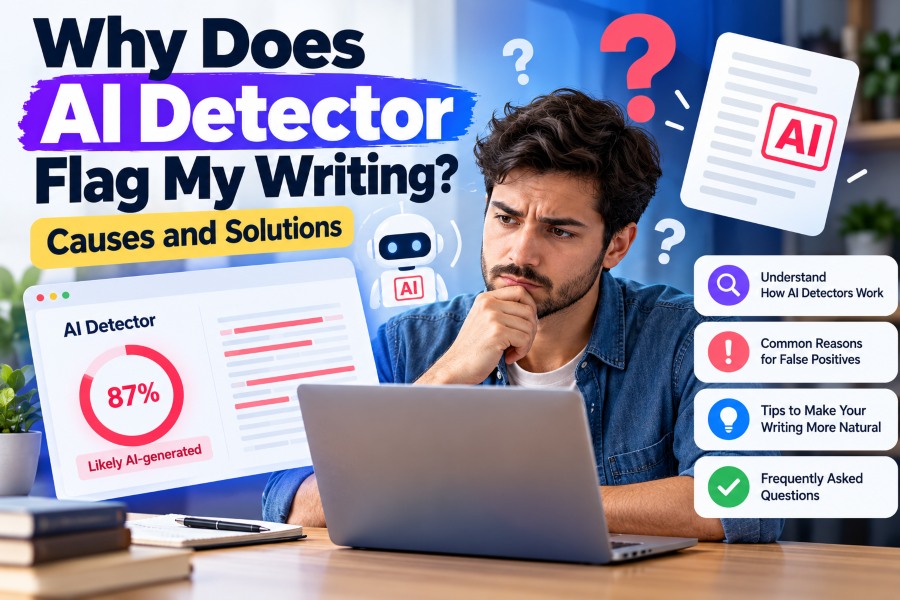
You spend hours researching a topic, organizing your ideas, and writing every sentence yourself. Then you run the finished content through an AI detector—and it says your writing is likely AI-generated.
Naturally, your first question is: Why does AI detector flag my writing when I wrote it myself?
The simple answer is that AI detectors do not actually know who wrote a piece of text. They analyze patterns in writing and estimate whether those patterns resemble content typically produced by artificial intelligence.
That distinction is important.
Human writing can sometimes contain the same characteristics that an AI detector associates with AI-generated text. Formal language, predictable sentence structures, repetitive wording, consistent grammar, and low variation can all contribute to a false positive.
In this guide, we’ll explain why AI detectors may flag human writing, how AI detection works, what false positives are, and what you can do when your original content is incorrectly identified as AI-generated.
Why Does AI Detector Flag My Writing?
An AI detector may flag your writing because your text contains patterns its algorithm associates with AI-generated content.
These patterns can include:
- Highly predictable word choices
- Similar sentence lengths
- Repetitive sentence structures
- Consistently formal language
- Limited vocabulary variation
- Very polished grammar
- Generic transitions
- Repeated ideas or phrases
- Formulaic paragraph structures
- Low variation in writing rhythm
None of these characteristics proves that AI created the content.
For example, academic writers are often encouraged to use clear sentences, structured paragraphs, neutral language, and consistent terminology. Those same characteristics can sometimes resemble the predictable patterns AI detection systems are designed to identify.
This means completely human-written content can occasionally receive a high AI probability score.
How Does an AI Detector Work?
To understand why your writing gets flagged, it helps to understand what an AI detector is actually doing.
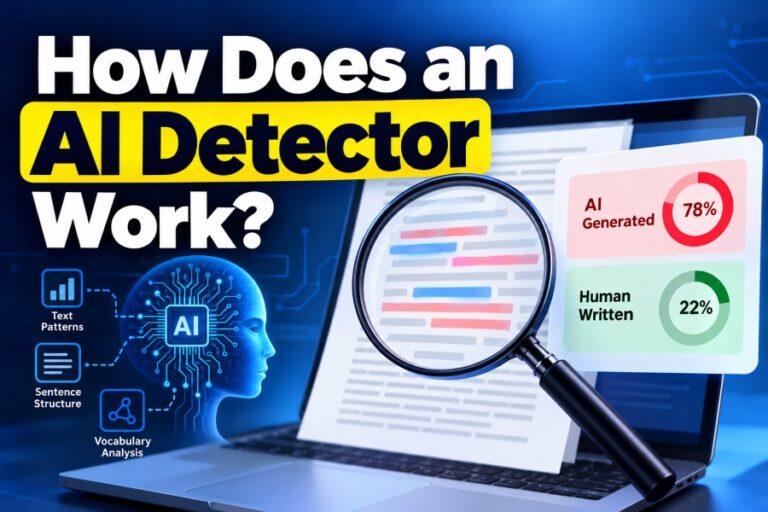
AI detectors generally analyze linguistic and statistical characteristics of a text. Depending on the system, this may include predictability, sentence patterns, vocabulary choices, syntax, repetition, and other signals.
The detector then uses its model to estimate whether the writing resembles text associated with humans or AI systems.
It is important to understand the word estimate.
An AI detector usually isn’t discovering hidden proof that ChatGPT or another AI system wrote your content. Instead, it is classifying the text based on patterns.
Think of it this way.
If an algorithm learns that AI-generated articles frequently contain smooth transitions, predictable sentences, and consistent paragraph structures, it may associate those characteristics with AI writing.
But a skilled human writer can produce exactly the same characteristics.
That’s where false positives can occur.
What Is a False Positive in AI Detection?
A false positive happens when an AI detector identifies human-written content as AI-generated.
Suppose you write a 1,500-word university assignment completely on your own.
You upload it to an AI detector and receive a result such as:
75% AI-generated
That percentage does not automatically mean 75% of your paper was created using AI.
Instead, it generally represents the detector’s assessment based on its own classification methodology.
If you genuinely wrote the entire paper yourself, the result may be a false positive.
This is one of the biggest reasons AI detector results should be interpreted carefully rather than treated as unquestionable proof of authorship.
1. Your Writing Is Too Predictable
Predictability is one factor commonly associated with AI-generated writing.
Language models generate text by predicting likely words based on context. Consequently, AI-generated sentences can sometimes follow highly probable linguistic patterns.
Human writing can do the same.
Consider:
Regular exercise can improve your physical and mental health.
This sentence is clear, grammatically correct, and predictable. There are only so many natural ways to communicate the idea.
If an entire article contains similarly straightforward sentences, a detector may identify stronger machine-like patterns.
This does not mean you should deliberately make your writing confusing. Clear writing is generally a strength.
It simply demonstrates why predictability alone cannot establish authorship.
2. Your Sentence Structures Are Too Similar
Humans naturally vary sentence structures when communicating.
One sentence may be short.
Another might be longer and contain several clauses explaining a more complicated idea.
AI-generated writing can sometimes maintain a more consistent rhythm.
If your own writing follows the same pattern repeatedly, however, a detector may interpret that consistency as an AI-related signal.
For example:
AI detectors analyze text patterns. AI detectors evaluate sentence structures. AI detectors examine vocabulary choices. AI detectors calculate a probability score.
Every sentence follows nearly the same structure.
Compare that with:
AI detectors analyze patterns within text, including sentence structure and vocabulary. Some systems also consider how predictable particular word combinations appear. The result? An estimate of whether the writing resembles AI-generated content.
The second version contains more structural variation.
3. Your Writing Is Extremely Polished
Perfect grammar sounds like something every writer should want.
It usually is.
However, unusually consistent grammar, punctuation, sentence construction, and tone can sometimes resemble machine-generated content.
Humans frequently make small stylistic choices that create variation.
We use contractions. Change rhythm. Start sentences differently. Occasionally use fragments for emphasis.
Professional editors may remove many of those characteristics when polishing content.
As a result, heavily edited human writing can sometimes appear more statistically uniform.
Again, that doesn’t make polished writing bad. It demonstrates a limitation of trying to identify authorship from linguistic patterns alone.
4. You Use Repetitive Transitions
AI-generated articles are often associated with recurring transition phrases.
Examples include:
- Furthermore
- Moreover
- Additionally
- In conclusion
- On the other hand
- It is important to note that
- Another important factor is
- In today’s digital world
Humans use these expressions too.
The problem appears when the same predictable transitions occur throughout an article.
For example, beginning five consecutive sections with “Additionally” creates an obvious structural pattern.
Try using transitions only when they genuinely improve readability.
Sometimes you don’t need a transition at all.
5. Your Vocabulary Has Little Variation
Repeated vocabulary can make writing appear formulaic.
Suppose an article repeatedly uses:
AI detectors analyze content to determine whether the content contains AI-generated patterns. These patterns help AI detectors analyze whether the content was generated by AI.
The meaning is understandable, but the vocabulary is highly repetitive.
Natural editing could produce:
AI detection tools examine linguistic patterns to estimate whether a passage resembles machine-generated text. They may consider factors such as predictability, sentence structure, and vocabulary.
The goal isn’t to replace every simple word with a complicated synonym.
Instead, remove unnecessary repetition while preserving clarity.
6. Your Sentences Are Consistently the Same Length
Sentence-length variation contributes to natural writing rhythm.
Consider this paragraph:
AI detection is becoming common in education. Students frequently check their assignments before submission. Writers also use detection tools for online content. Businesses sometimes use them when reviewing submissions.
Every sentence has a similar length.
Now compare:
AI detection is becoming increasingly common in education. Students may check assignments before submitting them, while writers sometimes test articles to understand how detection systems interpret their work. Businesses use these tools too. Their purposes, however, can vary considerably.
The second paragraph changes pace.
Some sentences are short. Others provide more detail.
This kind of variation can also make content more engaging for readers.
7. Your Academic Writing Sounds Formulaic
Students frequently ask:
Why does an AI detector say my essay is AI-written?
Academic writing is particularly vulnerable to false positives because students are often taught to follow strict conventions.
A typical essay might contain:
- An introduction
- A thesis statement
- Topic sentences
- Supporting evidence
- Formal language
- Consistent terminology
- Structured transitions
- A conclusion
These features create predictable patterns.
Technical and scientific writing can be even more standardized because accuracy often requires repeating specific terminology rather than replacing it with creative alternatives.
Therefore, a detector result should be considered alongside the broader evidence about how a document was produced.
8. English Isn’t Your First Language
Writers using English as an additional language may rely on structures they know are grammatically safe.
For example, they may use straightforward sentences, common vocabulary, or familiar transitions more consistently.
Those choices can make writing statistically predictable.
This does not mean multilingual writers naturally write like AI.
Rather, it highlights another reason automated classification should be interpreted cautiously.
Writers should not feel pressured to introduce grammatical mistakes simply to satisfy an AI detector.
Accuracy and clarity remain more important.
9. You Used Grammar or Editing Tools
There is an important difference between writing content with generative AI and using software to edit your own writing.
A writer might create an entire article manually and then use a grammar checker to fix:
- Spelling
- Punctuation
- Grammar
- Awkward sentences
- Wordiness
Extensive automated editing can make the final text more uniform.
If a tool rewrites entire sentences rather than simply correcting mistakes, the effect can be even greater.
When authorship matters, maintaining earlier drafts and revision history can provide more useful context than relying exclusively on an AI detection score.
10. Your Topic Has Limited Ways to Explain It
Some subjects naturally require predictable terminology.
Imagine writing about:
How to reset a Wi-Fi router.
The instructions will probably contain words such as:
- Router
- Power
- Reset button
- Internet
- Connection
- Device
- Network
You cannot realistically avoid these terms without making the instructions less accurate.
The same issue appears in medicine, law, programming, engineering, finance, and academic research.
Specialized terminology is often necessary.
Repeated terminology alone shouldn’t be interpreted as proof of AI authorship.
Why Do Different AI Detectors Give Different Results?
You might test the same article using several AI detectors and receive dramatically different results.
For example, one system might classify your text as mostly human while another identifies a large portion as potentially AI-generated.
Why?
Because AI detectors can use different:
- Training datasets
- Classification models
- Statistical signals
- Thresholds
- Scoring systems
- Text-processing methods
There is no universal AI-detection standard that every tool follows.
The disagreement between systems is another reason a percentage should not be interpreted as an absolute measurement of authorship.
Can AI Detectors Be Wrong?
Yes.
AI detectors can produce both false positives and false negatives.
A false positive occurs when human writing is classified as AI-generated.
A false negative occurs when AI-generated writing is classified as human.
Both errors matter.
If a detector misses AI content, its usefulness decreases. If it falsely identifies human writing, someone could face an unfair accusation.
For that reason, an AI detection score is better treated as one signal rather than definitive proof.
What Should I Do If My Writing Gets Flagged as AI?
If you genuinely wrote the content yourself, don’t immediately rewrite the entire document simply because a detector produced a high score.
First, review the flagged passages.
Look for excessive repetition, unnatural phrasing, repetitive transitions, or unnecessarily formulaic structures.
Improve those sections because they affect writing quality—not merely because you’re trying to change a detector score.
You can also preserve evidence of your writing process.
Useful evidence may include:
- Earlier drafts
- Research notes
- Document revision history
- Outlines
- Sources
- Version history
- Teacher or editor feedback
These materials can demonstrate how your work developed over time.
How to Make Your Writing More Natural
Good human writing isn’t about deliberately avoiding AI detection.
It’s about communicating ideas naturally and effectively.
Start by varying sentence structure.
Mix concise statements with longer explanatory sentences. Avoid repeatedly starting paragraphs in exactly the same way.
Next, eliminate unnecessary repetition.
If you’ve explained something clearly once, don’t restate the same point three different ways simply to increase word count.
Use specific examples whenever appropriate.
Instead of writing:
Technology helps businesses improve productivity.
You could write:
A small support team, for example, might use automation to categorize incoming tickets before an employee responds.
Specific details make explanations more useful.
Most importantly, preserve your own perspective and reasoning.
Original observations, relevant examples, genuine experiences, and thoughtful analysis can make content more valuable regardless of what an automated detector reports.
Should I Change My Writing Just to Pass an AI Detector?
Usually, your primary goal should be improving the writing itself rather than chasing a particular detector score.
Trying to manipulate every sentence until a detector reports “human” can actually make good writing worse.
You might introduce:
- Unnecessary complexity
- Awkward vocabulary
- Grammar mistakes
- Random sentence fragments
- Unnatural phrasing
A low AI score doesn’t automatically mean an article is good.
Similarly, a high score doesn’t automatically prove that it was generated by AI.
Focus on originality, accuracy, clarity, evidence, and usefulness.
Are AI Detector Scores Proof of AI Use?
An AI detection score should not be confused with direct evidence of how a document was created.
The detector sees the submitted text.
It generally does not see the complete writing process that produced it.
For example, it may not know whether you:
- Spent three hours researching the subject
- Created an outline
- Wrote several drafts
- Received feedback
- Revised individual paragraphs
- Corrected grammar
- Reorganized sections
Those contextual details can matter when determining authorship.
This is especially important in education, where an incorrect accusation could have serious consequences for a student.
How Can Students Prove They Wrote Their Work?
If your teacher questions your work because of an AI detection result, documentation can help establish your writing process.
Keep your notes and drafts whenever possible.
Writing in software with version history can also create a useful timeline showing how the document developed.
You may be able to explain:
- How you selected the topic
- Which sources you researched
- How you developed your argument
- Why you structured the paper a certain way
- What revisions you made
Someone who genuinely understands and created a paper will often be able to discuss its reasoning, sources, and development in detail.
AI Detection vs. Plagiarism Detection
AI detection and plagiarism detection are not the same thing.
A plagiarism checker generally looks for similarities between submitted text and existing material in databases, websites, publications, or other documents.
AI detection attempts to classify linguistic patterns associated with machine-generated writing.
Therefore, original human writing could theoretically receive:
0% plagiarism but a high AI score.
Likewise, AI-generated content could contain no directly copied material and therefore receive a low plagiarism similarity score.
The two systems measure different things.
Frequently Asked Questions
Why is my writing detected as AI when I wrote it myself?
Your writing may contain predictable vocabulary, consistent sentence structures, repetitive transitions, or other patterns that an AI detector associates with machine-generated content. This can produce a false positive.
Can human writing be detected as AI?
Yes. AI detectors can incorrectly classify human-written text as AI-generated. No automated classification system should be assumed to be perfect.
Does perfect grammar trigger AI detectors?
Perfect grammar alone does not prove AI use. However, highly consistent grammar combined with predictable sentences and uniform writing patterns may influence some detection systems.
Why does my essay say it is 100% AI-generated?
A high AI score means the detector found patterns that strongly match its AI classification criteria. It does not independently prove that an AI system wrote the essay.
Why do AI detectors keep flagging me?
Your natural writing style may be structured, concise, repetitive, or highly predictable. Academic or technical writing can also contain standardized patterns that influence detection results.
Can Grammarly make writing appear AI-generated?
Grammar and rewriting tools can alter sentence structure and make writing more polished or consistent. Depending on how extensively a tool rewrites the text, this may affect how some AI detectors classify it.
How do I stop my writing from being flagged as AI?
Focus on improving genuine writing quality rather than manipulating a detector. Use natural sentence variation, remove unnecessary repetition, include specific examples, develop original analysis, and preserve your drafts and revision history.
Are AI detectors accurate?
AI detectors can identify patterns associated with AI-generated content, but they can also make classification errors. Their results should therefore be interpreted with appropriate context rather than treated as unquestionable proof.
Final Thoughts
If you’ve been wondering “why does AI detector flag my writing?”, the most important thing to understand is that an AI detector is making a classification based on textual patterns. It does not automatically know whether you personally wrote the content.
Human writing can sometimes be predictable, polished, repetitive, or highly structured. Academic and technical writing are especially likely to contain standardized language and consistent terminology.
That’s why false positives can happen.
If your original writing gets flagged, review it for genuine quality issues such as repetition, weak examples, monotonous sentence structures, or generic explanations. At the same time, preserve drafts, research notes, and revision history when authorship needs to be demonstrated.
Ultimately, don’t sacrifice clear, accurate, useful writing simply to achieve a particular AI detector score.
Write naturally. Develop your own ideas. Support your claims. Edit carefully.
Those qualities matter far more than a percentage generated by an automated classifier.

Comments
0 responsesNo comments yet. Be the first to share your thoughts.