

Opens in a new tab. Your article title and link are shared only with the AI assistant you choose.
Artificial intelligence has quickly become part of education. Students use AI tools to brainstorm ideas, understand difficult concepts, improve grammar, summarize research, and sometimes generate entire assignments. As AI-generated writing becomes more common, teachers and educational institutions are also looking for ways to identify content that may have been created by artificial intelligence.
This raises an increasingly common question among students:
What AI detector do teachers use?
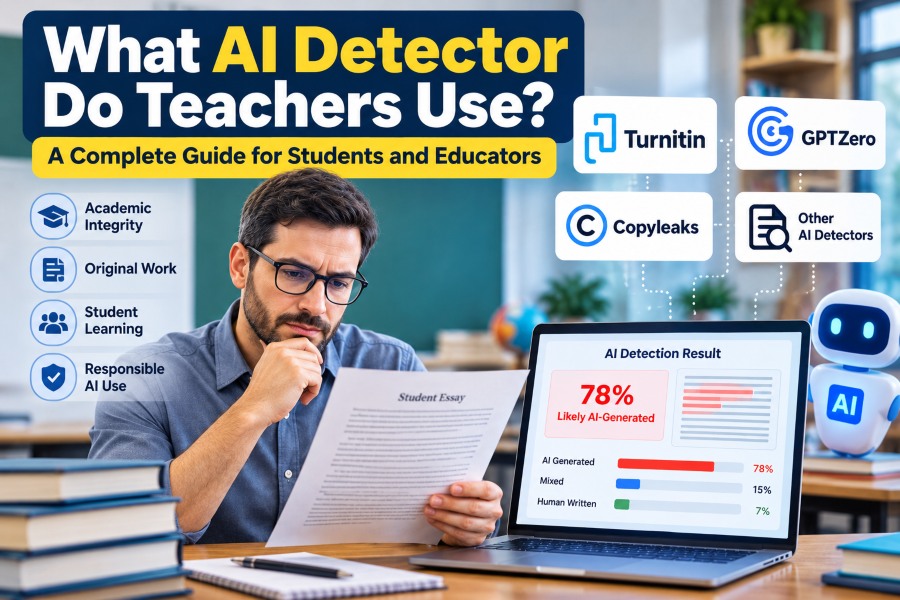
Teachers may use AI detection tools such as Turnitin’s AI writing detection system, GPTZero, Copyleaks, and other AI-content checkers available to schools or individual educators. The exact tool depends on the school, learning management system, institutional policies, and teacher preferences.
However, AI detectors are not perfect. A detection result generally should not be treated as definitive proof that a student used AI. Understanding how these tools work, what teachers may use them for, and their limitations can help both students and educators approach AI-generated content more responsibly.
What Is an AI Detector?
An AI detector is a software tool designed to estimate whether a piece of text was written by a human or generated by an artificial intelligence model.
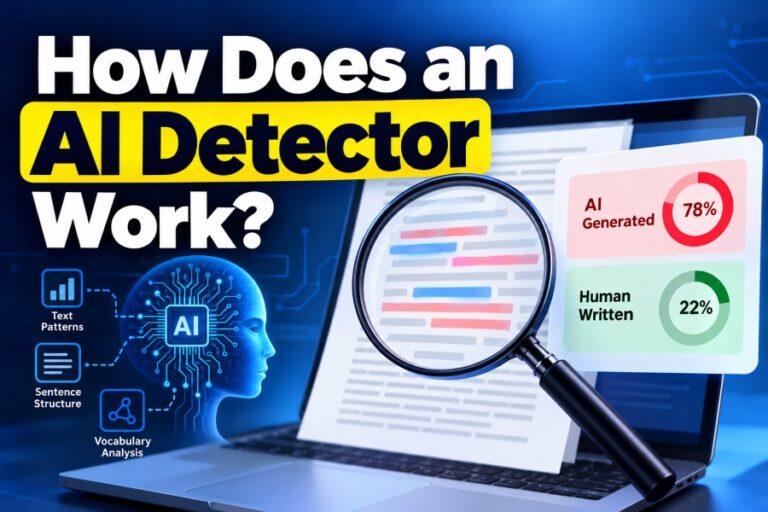
These systems typically analyze patterns within written content rather than discovering a hidden label that says “AI generated.”
Depending on the detector, the analysis may consider characteristics such as:
- Sentence structure
- Word predictability
- Writing consistency
- Vocabulary patterns
- Statistical relationships between words
- Variation in sentence length
- Linguistic patterns commonly associated with AI models
After processing the text, the detector may provide a score, classification, or percentage indicating how likely it believes the content is to be AI-generated.
For example, a detector might categorize text as predominantly human-written, potentially AI-generated, mixed, or uncertain.
The terminology and scoring system vary considerably between platforms.
What AI Detector Do Teachers Use?
There is no single AI detector used by every teacher.
Teachers may use whatever AI detection technology is provided by their school or university. Others independently use publicly available tools when reviewing assignments.
Some commonly known AI detection platforms in education include Turnitin, GPTZero, Copyleaks, and standalone AI content detection services.
1. Turnitin AI Writing Detection
Turnitin is already widely associated with academic integrity and plagiarism checking, so its AI writing detection capabilities can fit naturally into existing academic workflows.
Schools that already use Turnitin may provide instructors with access to AI-writing indicators alongside other similarity and integrity tools.
A teacher can submit or review student work through the institution’s Turnitin workflow and receive information that may indicate portions of qualifying text that the system considers potentially AI-generated.
It is important to distinguish AI detection from plagiarism detection.
Plagiarism detection compares submitted writing with existing sources and identifies similarities. AI detection instead analyzes characteristics of the writing to estimate whether it may have been produced by a generative AI system.
They address related academic-integrity concerns but operate differently.
2. GPTZero
GPTZero is another AI detection platform commonly associated with education.
It was developed specifically around the challenge of distinguishing human writing from AI-generated text. Students, teachers, institutions, and other organizations can use the platform to analyze written material.
Depending on the available product features, GPTZero may provide an overall assessment and sentence-level information about potentially AI-generated writing.
For teachers, this type of information can serve as one signal when reviewing a suspicious assignment.
However, an AI detection score should still be interpreted carefully rather than treated as unquestionable evidence.
3. Copyleaks
Copyleaks provides plagiarism and AI content detection capabilities and is another platform that may be used within educational environments.
An instructor can analyze text to look for patterns associated with AI-generated writing. Institutions may also integrate detection technology into broader educational workflows.
Having plagiarism and AI-content analysis available within related systems can make these tools particularly relevant for schools that need to evaluate large volumes of written assignments.
As with other detection systems, the output represents an algorithmic assessment rather than absolute proof about how a document was created.
4. Other Online AI Detectors
Not every teacher works at an institution that provides a dedicated AI detection system.
Some instructors may therefore use independent online AI checkers.
These tools usually work in a simple way:
A teacher copies the student’s text, pastes it into the detector, starts the scan, and reviews the resulting AI probability or classification.
The quality and reliability of these services can vary substantially. Results from different detectors can also disagree with one another.
For this reason, teachers should consider the quality of the detector and the broader context surrounding an assignment.
Why Do Teachers Use AI Detectors?
Teachers use AI detectors primarily because generative AI has made it extremely easy to create polished text quickly.
A student can enter a prompt into an AI system and receive an essay, report, explanation, or discussion response within seconds.
This creates several challenges for educators.
Maintaining Academic Integrity
Assignments are generally intended to measure what students understand and what they can produce independently.
If AI completes an assignment that was supposed to demonstrate a student’s own knowledge, the teacher may no longer be able to accurately evaluate that student’s abilities.
AI detection can therefore become one component of an academic-integrity process.
Evaluating Student Learning
Writing assignments are often about more than producing grammatically correct paragraphs.
Teachers may use them to evaluate:
- Critical thinking
- Research ability
- Subject knowledge
- Argument development
- Communication skills
- Evidence selection
- Original interpretation
Submitting entirely AI-generated work can interfere with those learning objectives.
Enforcing Classroom AI Policies
Schools and individual instructors increasingly establish policies explaining when AI tools are permitted.
For example, a teacher might allow AI for brainstorming but prohibit it from writing the final assignment.
Another teacher may allow AI-assisted editing if students disclose their use of the technology.
Detection tools can help instructors investigate whether submitted work is consistent with those policies.
How Do AI Detectors Work?
AI detectors usually rely on statistical and machine-learning techniques to identify patterns associated with machine-generated text.
They do not simply search a database containing every response ever generated by an AI model.
Instead, they examine characteristics of the submitted writing.
Two concepts frequently discussed in relation to AI detection are predictability and variation.
Text Predictability
Language models generate text by predicting likely words based on previous context.
Because of this process, AI-generated writing may sometimes contain patterns that are statistically more predictable than naturally produced human writing.
Detection systems may analyze these patterns to estimate whether a language model could have generated the content.
Variation in Writing
Human writing naturally contains variation.
People may alternate between long and short sentences, use unexpected expressions, change sentence structures, or occasionally write imperfectly.
AI-generated writing can sometimes appear more consistently structured.
Detection algorithms may analyze this variation as another signal.
Modern AI models, however, are becoming increasingly sophisticated, making simple distinctions between “AI writing” and “human writing” difficult.
Can Teachers Tell If You Use AI?
Sometimes teachers may notice signs of AI assistance without using a detector at all.
Teachers frequently read multiple assignments from the same student. Over time, they can become familiar with that student’s vocabulary, sentence structure, reasoning ability, and typical writing style.
A sudden change may attract attention.
For example, a teacher might notice that an assignment uses unusually advanced terminology compared with a student’s previous work.
Other potential signals include vague explanations, fabricated citations, repetitive structures, unsupported claims, or writing that does not closely address the assignment instructions.
None of these characteristics proves that AI was used.
A student’s writing can improve, and human-written work can contain many of the same patterns.
This is why contextual review matters.
Are AI Detectors Accurate?
AI detectors can identify patterns associated with generated text, but their results should not be considered perfectly accurate.
Both false positives and false negatives can occur.
False Positives
A false positive occurs when human-written content is incorrectly classified as AI-generated.
This can be particularly concerning in education because a student may have legitimately completed an assignment and still receive an AI-related flag.
Certain types of highly structured or predictable writing may be more difficult for detection systems to classify confidently.
False Negatives
The opposite can also happen.
AI-generated content may sometimes be classified as human-written.
AI models continue to improve, and generated text can be edited substantially before being submitted.
Therefore, passing an AI detector does not prove that something was written entirely by a person.
Can Different AI Detectors Give Different Results?
Yes.
The same text can produce different results when analyzed by different AI detectors.
One tool might classify a passage as likely AI-generated while another considers it mostly human-written.
This happens because AI detectors can use different:
- Training datasets
- Machine-learning models
- Detection thresholds
- Classification systems
- Linguistic features
- Scoring methodologies
This variation is one reason detection percentages should be interpreted as estimates rather than universal measurements.
An “80% AI” result from one platform does not necessarily mean another detector will return the same score.
Can Teachers Detect ChatGPT?
AI detectors may attempt to identify text produced by ChatGPT and other generative AI systems.
However, detecting the exact source of a piece of writing is considerably more complicated than identifying general patterns associated with machine-generated content.
A detector may indicate that a passage resembles AI-generated writing, but that does not necessarily establish which model generated it.
Students should therefore avoid thinking about AI detection as a simple system that definitively labels every ChatGPT response.
The technology works through probability and pattern recognition.
Can Teachers Detect AI After You Edit the Text?
Editing AI-generated text can change the patterns a detector analyzes.
The degree of change depends on how extensively the content is revised.
However, students should not approach editing as a method for defeating AI detection.
The more important issue is complying with the academic policy for the assignment.
If AI assistance is allowed, students should follow any disclosure or citation requirements established by their teacher or institution.
If AI-generated writing is prohibited, rewriting generated text specifically to evade detection may still violate the rules even if a detector does not flag it.
What Happens If an AI Detector Flags an Assignment?
The procedure varies by school and instructor.
An AI detection result may prompt a teacher to review the assignment more carefully rather than immediately conclude that academic misconduct occurred.
A teacher could compare the submission with previous work, review document history, examine sources, or ask the student to explain the arguments and research process.
Students may also be asked to provide supporting materials such as:
- Research notes
- Drafts
- Outlines
- Source materials
- Version history
- Citation records
These materials can provide useful context about how the assignment developed.
How Can Students Show That Their Work Is Original?
Students who write their assignments independently can take several practical steps to document their writing process.
Keep Your Drafts
Do not automatically delete early drafts.
Drafts demonstrate how an assignment evolved from an initial idea into the final version.
Save Your Research Notes
Keep notes about the sources you used, important quotations, statistics, arguments, and ideas.
These notes can help demonstrate your research process.
Use Version History
Cloud-based writing platforms often maintain revision histories.
Version history can show gradual writing and editing over time rather than the sudden appearance of an entire completed essay.
Cite Sources Properly
Accurate citations strengthen academic work and make it easier to distinguish your research from unsupported generated information.
Understand What You Submit
You should be able to explain the arguments, evidence, terminology, and conclusions in your assignment.
If a teacher asks why you made a particular argument, you should understand the reasoning behind it.
Should Teachers Rely Only on AI Detectors?
AI detectors are better understood as one source of information rather than a complete academic-integrity system.
An AI score by itself does not explain exactly how a document was created.
A more comprehensive review may consider the student’s previous writing, assignment requirements, drafts, citations, revision history, and ability to discuss the submitted work.
This approach is particularly important because incorrectly accusing a student of using AI can have serious academic consequences.
Detection results therefore benefit from human review and additional evidence.
AI Detection vs. Plagiarism Detection
AI detection and plagiarism detection are often confused, but they solve different problems.
Plagiarism detection looks for similarities between submitted writing and existing material.
AI detection analyzes writing patterns to estimate whether content may have been generated by an artificial intelligence system.
A completely original AI-generated paragraph might have no plagiarism matches while still triggering an AI detector.
Similarly, a human-written paragraph copied from another website could trigger plagiarism detection without appearing AI-generated.
Educational institutions may therefore use both technologies.
How Should Students Use AI Responsibly?
AI does not necessarily need to be avoided completely.
Its appropriate use depends on the rules established for a particular class or assignment.
When permitted, AI can potentially help students brainstorm topics, clarify difficult concepts, generate practice questions, improve organization, or identify grammar problems.
The key distinction is between using AI as a learning assistant and using it as a replacement for the student’s required work.
Before using an AI tool for an assignment, students should check the instructor’s policy.
When the policy is unclear, asking the teacher is safer than assuming a particular type of AI assistance is acceptable.
Frequently Asked Questions
What AI detector do most teachers use?
There is no universal detector used by all teachers. Depending on their institution and available software, teachers may encounter tools such as Turnitin, GPTZero, Copyleaks, or other AI-content detection systems.
Do teachers use Turnitin to detect AI?
Schools using Turnitin may have access to AI-writing detection capabilities depending on their product configuration and institutional setup. Turnitin is also widely known for similarity and plagiarism-related tools.
Can teachers detect ChatGPT-generated writing?
Teachers may use AI detection tools and contextual evidence to identify writing that potentially involved generative AI. However, detection results are probabilistic and are not guaranteed to correctly identify every AI-generated passage.
Is GPTZero used by teachers?
GPTZero is designed for AI-content detection and is used in educational and other environments. Individual teachers may use it independently, while some organizations may incorporate AI detection into broader workflows.
Can AI detectors be wrong?
Yes. AI detectors can produce false positives and false negatives. A human-written document can potentially be flagged as AI-generated, while AI-generated content may sometimes avoid detection.
Can teachers see exactly which AI tool you used?
Generally, an AI detector’s classification should not be interpreted as definitive identification of the exact AI model that produced a passage. Detection systems typically analyze patterns associated with machine-generated writing.
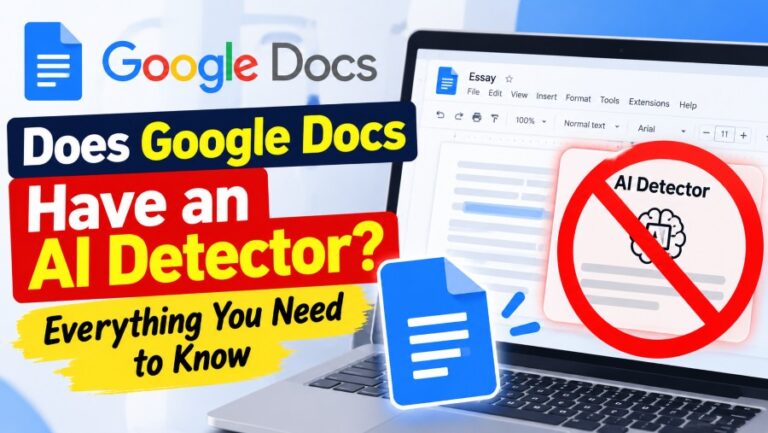
Can teachers detect AI in Google Docs?
A teacher may review text copied or submitted from Google Docs using an AI detection system. Depending on access and settings, document revision history may also provide context about how the work was created.
Does an AI detector prove that someone cheated?
An AI detector score alone does not necessarily prove academic misconduct. Institutional rules, the student’s writing process, supporting evidence, and human review can all be relevant.
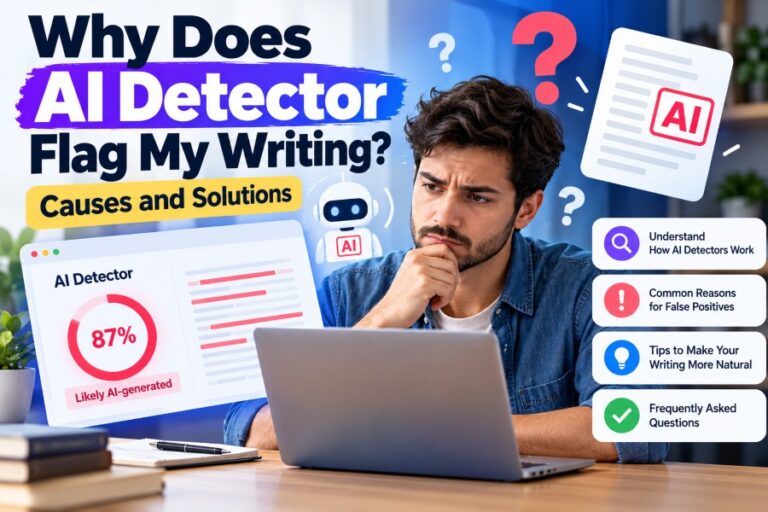
Why does my own writing get detected as AI?
AI detectors make predictions based on linguistic and statistical patterns. Human writing can sometimes contain patterns similar to generated text, potentially resulting in a false positive.
Should students check their work with an AI detector?
Students may use detection tools to understand how automated systems classify text, but a detector score cannot guarantee how another platform will evaluate the same content. Following the teacher’s AI policy and keeping evidence of the writing process are more dependable practices.
Final Thoughts
So, what AI detector do teachers use?
Teachers may use Turnitin, GPTZero, Copyleaks, and other AI-content detection tools, depending on what their school provides and what tools they choose independently.
However, no AI detector should be viewed as a perfect judge of authorship. These systems analyze patterns and generate estimates, meaning both incorrect flags and missed AI-generated content are possible.
For students, the safest approach is straightforward: understand the AI policy for each assignment, complete the required work yourself, properly disclose permitted AI assistance, cite sources accurately, and keep drafts or revision history when possible.
For educators, AI detection can provide useful signals, but those signals become more meaningful when combined with human review, knowledge of the student’s work, and evidence of the writing process.
As generative AI continues to develop, education will likely rely less on a simple question of whether AI was used and more on a broader question: Was AI used in a way that supports learning and follows the rules of the assignment?

Comments
0 responsesNo comments yet. Be the first to share your thoughts.