

Opens in a new tab. Your article title and link are shared only with the AI assistant you choose.
Artificial intelligence can now produce essays, articles, emails, product descriptions, social media posts, and many other types of written content within seconds. As AI-generated writing becomes increasingly common, people are also looking for ways to determine whether a piece of text was written by a human or generated by an AI system.
This is where AI detectors come in.
But how does an AI detector work, and can it actually tell the difference between human and AI-generated content?
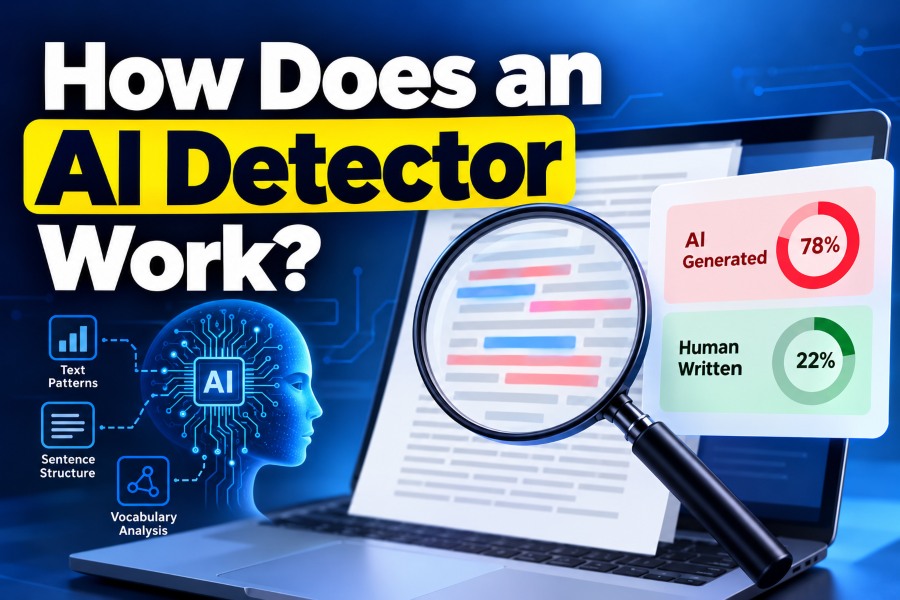
An AI detector analyzes patterns within text and estimates whether those patterns are more consistent with AI-generated or human-written content. Depending on the detection system, it may examine predictability, sentence structure, vocabulary patterns, statistical characteristics, and signals learned from large collections of human and AI-generated text.
However, AI detection is not perfect. Detection results should generally be treated as probability-based assessments rather than absolute proof of authorship.
In this guide, we’ll explain how AI detectors work, what they look for, why results can vary, and how to interpret an AI detection score responsibly.
What Is an AI Detector?
An AI detector is a software tool designed to estimate whether text may have been generated by an artificial intelligence model.
These tools are commonly used to analyze content such as:
- Essays and academic assignments
- Blog posts and articles
- Marketing copy
- Product descriptions
- Emails
- Reports
- Social media content
- AI-assisted writing
A user typically pastes text into the detector or uploads content for analysis. The system processes the writing and returns a result indicating how likely the text is to contain AI-generated patterns.
Some tools display a percentage, while others classify content using labels such as human-written, AI-generated, or mixed.
Importantly, these results represent an estimate. An AI detector does not usually have direct access to the writing history or know with certainty who—or what—created the text.
How Does an AI Detector Work?
An AI detector works by analyzing linguistic and statistical patterns in written content and comparing them with patterns commonly associated with human and AI-generated writing.
Modern language models generate text by predicting likely words or tokens based on the context that comes before them. Because of this process, AI-generated writing can sometimes exhibit measurable patterns.
Detection systems attempt to identify those patterns.
Although every detector can use a different methodology, the process generally involves several stages.
1. The Text Is Processed
The first step is preparing the submitted content for analysis.
The detector may break the text into smaller units such as:
- Words
- Tokens
- Sentences
- Paragraphs
- Character sequences
It can then analyze relationships between these units.
Cleaning and preprocessing may also remove formatting that does not contribute meaningfully to the analysis.
Once the text has been prepared, the detector can begin examining its linguistic characteristics.
2. The Detector Analyzes Text Predictability
Predictability is one signal that may be considered by AI detection systems.
AI language models generate text by estimating which token is likely to appear next based on previous context. As a result, generated text may sometimes follow statistically predictable patterns.
Human writing can be less predictable.
People may suddenly change sentence structures, introduce unusual expressions, make stylistic choices, or use unexpected vocabulary.
An AI detector can analyze these patterns and determine whether the text resembles characteristics observed in machine-generated writing.
However, predictable writing is not automatically AI-generated.
Technical documentation, formal academic writing, simple explanations, and highly edited human content can also contain predictable language.
What Is Perplexity in AI Detection?
Perplexity is a statistical concept frequently discussed in relation to AI-generated text.
In simple terms, perplexity describes how predictable a sequence of words is to a language model.
Consider these sentences:
Sentence A:
“The dog ran across the yard.”
Sentence B:
“The dog unexpectedly zigzagged through the rain-soaked garden.”
The first sentence follows a very common linguistic structure and may be relatively predictable. The second contains more unusual word combinations.
Some detection approaches use measures related to this type of predictability as one signal when evaluating content.
Lower unpredictability can sometimes be associated with machine-generated text, while more unexpected language may sometimes appear more frequently in human writing.
But perplexity alone cannot reliably determine authorship.
A human can intentionally write simple, predictable sentences, while an AI model can generate creative and highly varied language.
That is why stronger detection systems generally consider multiple characteristics rather than relying on one measurement.
What Is Burstiness?
Burstiness refers to variation in sentence structure, sentence length, vocabulary, or writing rhythm.
Human writing often changes naturally throughout a passage.
For example, someone might write a long explanatory sentence followed by a short one.
Then another.
After that, they might return to a more detailed paragraph.
AI-generated text can sometimes display more consistent patterns in sentence length and structure, although modern models can also produce substantial variation.
A detector may therefore examine factors such as:
- Sentence-length variation
- Paragraph structure
- Vocabulary changes
- Repeated sentence patterns
- Writing rhythm
- Structural consistency
Greater or lower burstiness is not proof that text is human- or AI-generated. It is simply one possible signal within a broader analysis.
3. Sentence Structure Is Examined
AI detectors may also analyze how sentences are constructed.
This can include characteristics such as:
- Average sentence length
- Grammatical patterns
- Transition usage
- Clause structure
- Repetition
- Sentence openings
- Punctuation patterns
AI-generated content sometimes uses recurring structures, particularly when generating long informational articles.
For example, it might repeatedly use transitions such as:
“Additionally…”
“Furthermore…”
“However…”
“In conclusion…”
Humans use these expressions too, so their presence alone does not indicate AI authorship.
Instead, a detector may evaluate how frequently particular structures occur and how they interact with other linguistic signals.
4. Vocabulary Patterns Are Evaluated
Word choice can provide additional statistical information.
A detector may analyze vocabulary diversity and how words are distributed throughout a document.
Possible signals include:
- Repeated phrases
- Common word combinations
- Vocabulary diversity
- Unusual word frequency
- Contextual word choices
- Repetitive transitions
Some AI-generated content can sound polished but repetitive, particularly when similar concepts are explained several times.
Human writing may contain more individual stylistic variation.
However, this distinction continues to become less clear as AI writing systems improve.
5. Machine Learning Models May Classify the Text
Many AI detectors use machine learning classifiers trained on examples of both human-written and AI-generated text.
During training, the system learns patterns that statistically distinguish the two categories within its training data.
For example, developers may provide thousands or millions of text samples labeled as:
Human-written
or
AI-generated
The model then learns which combinations of features are associated with each category.
When new content is submitted, the classifier compares its characteristics with patterns learned during training.
The result may then be converted into an AI probability or classification score.
6. Multiple Signals Are Combined
Reliable AI detection generally requires more than a single metric.
A detector might combine information related to:
- Text predictability
- Sentence variation
- Syntax
- Vocabulary
- Repetition
- Semantic patterns
- Token distributions
- Classifier predictions
These signals can be combined into an overall assessment.
For example, a tool might return:
Likely human-written
or:
72% probability of AI-generated content
The exact meaning of these scores depends on the detector. A 72% score does not necessarily mean that exactly 72% of the document was written by AI.
Users should check how a specific detector defines its results before drawing conclusions.
How Do AI Detectors Identify AI-Generated Content?
AI detectors generally do not search for a hidden label that says, “This was written by AI.”
Instead, they look for patterns.
Imagine examining hundreds of paintings from two different artists. After enough examples, you might begin recognizing differences in brush strokes, color choices, composition, or technique.
AI detection follows a somewhat similar principle.
The system learns characteristics associated with different types of writing and attempts to classify new content based on those characteristics.
The challenge is that human and AI writing increasingly overlap.
Humans can write in highly structured ways, while modern AI systems can imitate conversational, creative, technical, and irregular writing styles.
This makes AI detection a difficult classification problem.
What Does an AI Detection Score Mean?
AI detection scores can easily be misunderstood.
Suppose a detector reports:
80% AI
That does not always mean the tool has proven that 80% of the content was generated by artificial intelligence.
Depending on the tool, the score might represent the classifier’s confidence, an estimated probability, or the proportion of sentences flagged as potentially AI-generated.
Different platforms calculate and present their results differently.
Before interpreting a score, check what the detector says the number represents.
A detection result is better viewed as a signal that may justify further review rather than definitive proof.
Can AI Detectors Be Wrong?
Yes.
AI detectors can produce incorrect classifications.
There are two particularly important types of errors.
False Positives
A false positive occurs when human-written content is incorrectly classified as AI-generated.
This may happen with writing that is:
- Highly structured
- Grammatically consistent
- Formal
- Repetitive
- Technical
- Written in simple language
Writers who use predictable sentence structures may therefore receive AI flags even when they created the content themselves.
False Negatives
A false negative happens when AI-generated content is classified as human-written.
This can occur when generated content has been:
- Extensively edited
- Rewritten
- Combined with human writing
- Produced with detailed prompting
- Modified to introduce greater stylistic variation
As AI models become more capable of producing diverse writing styles, distinguishing authorship based purely on text becomes increasingly difficult.
Why Do Different AI Detectors Give Different Results?
You might submit the same paragraph to several AI detection tools and receive completely different scores.
One detector could classify it as mostly human, while another might identify a high probability of AI generation.
This happens because detectors can differ in:
- Training datasets
- Classification models
- Detection algorithms
- Scoring methods
- Thresholds
- Supported languages
- Text-length requirements
- Model coverage
One detector might emphasize predictability, while another relies more heavily on a trained classifier.
Therefore, results from different AI detection systems are not necessarily directly comparable.
Does Editing AI Content Affect Detection?
Editing can significantly change the statistical characteristics of generated content.
Suppose someone generates a draft with an AI system and then substantially rewrites it.
They might:
- Change sentence structures
- Replace vocabulary
- Add original examples
- Remove repetitive sections
- Introduce personal insights
- Reorganize paragraphs
- Add new research
- Rewrite transitions
After extensive editing, the final text may differ considerably from the original AI-generated draft.
This creates a fundamental challenge for detection systems: authorship is not always binary.
A document can contain contributions from both humans and AI.
Can AI Detectors Detect ChatGPT?
Some AI detectors are designed to identify patterns associated with text generated by systems such as ChatGPT and other large language models.
However, there is no universal pattern that guarantees accurate identification.
Different AI models generate text differently, and their behavior can change as models are updated.
Prompting also matters.
The same model can produce formal academic writing, casual conversation, technical documentation, marketing copy, or creative storytelling.
As a result, a detector’s performance can vary depending on the model, writing style, topic, language, and length of the analyzed content.
How Much Text Does an AI Detector Need?
Generally, longer samples provide more linguistic information for analysis.
A short sentence such as:
“Digital marketing helps businesses reach customers online.”
contains relatively little information about authorship.
Thousands of humans and AI systems could produce exactly the same sentence.
A longer article provides more data about:
- Sentence variation
- Vocabulary distribution
- Structural patterns
- Repetition
- Writing rhythm
- Contextual consistency
For this reason, detection results based on very short passages should be interpreted particularly cautiously.
Are AI Detectors Accurate?
AI detector accuracy varies significantly depending on the detector, dataset, AI model, language, content type, and testing methodology.
No AI detector should automatically be considered 100% accurate.
Performance can also change over time.
A detector trained primarily on content from older AI models may perform differently when analyzing text generated by newer systems.
Similarly, a detector tested on English academic essays may not perform equally well on marketing copy, technical documentation, social media posts, or another language.
When evaluating accuracy claims, it is useful to look for information about:
- The testing dataset
- Sample size
- AI models tested
- Human content sources
- False-positive rates
- False-negative rates
- Languages tested
- Independent evaluation
A single accuracy percentage without this context provides limited information.
AI Detector vs Plagiarism Checker: What’s the Difference?
AI detection and plagiarism detection solve different problems.
A plagiarism checker compares submitted text with existing material to identify matching or highly similar passages.
An AI detector analyzes characteristics of the text itself to estimate whether it resembles AI-generated writing.
This means content can be:
- Original but AI-generated
- Human-written but plagiarized
- AI-generated and plagiarized
- Human-written and completely original
Therefore, plagiarism detection cannot automatically determine whether content was generated by AI, and AI detection cannot automatically determine whether content was copied.
Why Is AI Detection Difficult?
AI detection is challenging because both humans and machines use the same language.
There is no universal grammar rule that belongs exclusively to AI.
AI models learn from enormous collections of human-created text and attempt to reproduce natural language patterns.
At the same time, humans increasingly use digital writing tools for:
- Grammar correction
- Autocomplete
- Translation
- Rewriting
- Research
- Brainstorming
- Editing
The boundary between purely human-written and purely machine-generated content can therefore become unclear.
A person might create an outline manually, use AI for a first draft, rewrite half the article, run it through a grammar checker, and then add original examples.
Is that human-written or AI-generated?
The answer depends on how authorship is defined.
That ambiguity is one reason detection scores should be interpreted carefully.
How to Use an AI Detector Responsibly
AI detectors can be useful as screening tools, but their results should not automatically be treated as proof.
For better interpretation:
- Analyze a sufficiently large text sample.
- Review how the detector defines its score.
- Consider the possibility of false positives and false negatives.
- Examine suspicious sections manually.
- Consider writing history or draft evidence when available.
- Avoid making serious decisions based solely on one automated score.
For educators, publishers, employers, and content teams, AI detection can provide an additional signal.
It should ideally be combined with contextual evidence and human review.
The Future of AI Content Detection
AI-generated content and AI detection technologies are likely to continue evolving together.
Future detection systems may use more sophisticated classifiers, provenance technologies, metadata, or content-authenticity standards rather than relying entirely on linguistic patterns.
At the same time, AI-generated writing is becoming more flexible and natural.
This creates an ongoing challenge.
As the statistical differences between human and machine-generated writing become smaller, determining authorship from text alone may become increasingly difficult.
Rather than expecting perfect identification, AI detection may become one component of broader content-verification systems.
Frequently Asked Questions
How does an AI detector work?
An AI detector analyzes linguistic and statistical characteristics of text and estimates whether they resemble patterns associated with AI-generated or human-written content. Depending on the system, it may evaluate predictability, sentence structure, vocabulary, repetition, token patterns, and machine-learning classifier outputs.
Can AI detectors tell if ChatGPT wrote something?
AI detectors may identify patterns associated with ChatGPT-generated text, but they cannot always determine authorship with certainty. Results can vary based on the model, prompt, text length, editing, writing style, and detection method.
Are AI detectors 100% accurate?
No. AI detectors can produce both false positives and false negatives. Their accuracy depends on factors such as the detection model, training data, content type, language, AI model, and amount of text analyzed.
What makes text look AI-generated?
Potential signals can include highly predictable language, repetitive sentence structures, consistent writing patterns, recurring transitions, and statistical similarities to known AI-generated text. None of these characteristics alone proves AI authorship.
Can human writing be detected as AI?
Yes. Human-written content can sometimes receive an AI classification, particularly when the writing is formal, highly structured, repetitive, simple, or statistically predictable. This is known as a false positive.
Can edited AI content still be detected?
Sometimes. Extensive human editing can change many of the linguistic characteristics a detector analyzes, potentially making classification more difficult. Results depend on how much the content was changed and how the detector works.
Why do AI detectors show different percentages?
Different AI detectors use different datasets, models, thresholds, algorithms, and scoring systems. Because there is no single universal AI-detection method, the same content can receive different results from different tools.
Is AI detection the same as plagiarism detection?
No. Plagiarism detection searches for similarities between submitted content and existing sources. AI detection analyzes writing patterns to estimate whether text may have been generated by an AI model.
Final Thoughts
So, how does an AI detector work?
At its core, an AI detector examines patterns within written language and estimates whether those patterns are more consistent with human or machine-generated text.
Depending on the technology, the system may analyze predictability, sentence variation, vocabulary, syntax, repetition, token patterns, and features learned by machine-learning classifiers.
The important point is that AI detection is probabilistic.
A high AI score does not automatically prove that a person used artificial intelligence, just as a low score does not guarantee that the content was written entirely by a human.
As AI writing technology improves, detecting authorship from text alone is likely to remain challenging.
AI detectors are therefore most useful when treated as analytical tools rather than final judges. Understanding how they work—and where their limitations lie—makes it easier to interpret their results responsibly.


Comments
0 responsesNo comments yet. Be the first to share your thoughts.