

Opens in a new tab. Your article title and link are shared only with the AI assistant you choose.
Artificial intelligence has changed how people create written content. Students use AI for research and brainstorming, marketers use it to develop content ideas, and businesses use AI tools to speed up everyday writing tasks. As AI-generated content has become more common, another type of technology has grown alongside it: the AI detector.
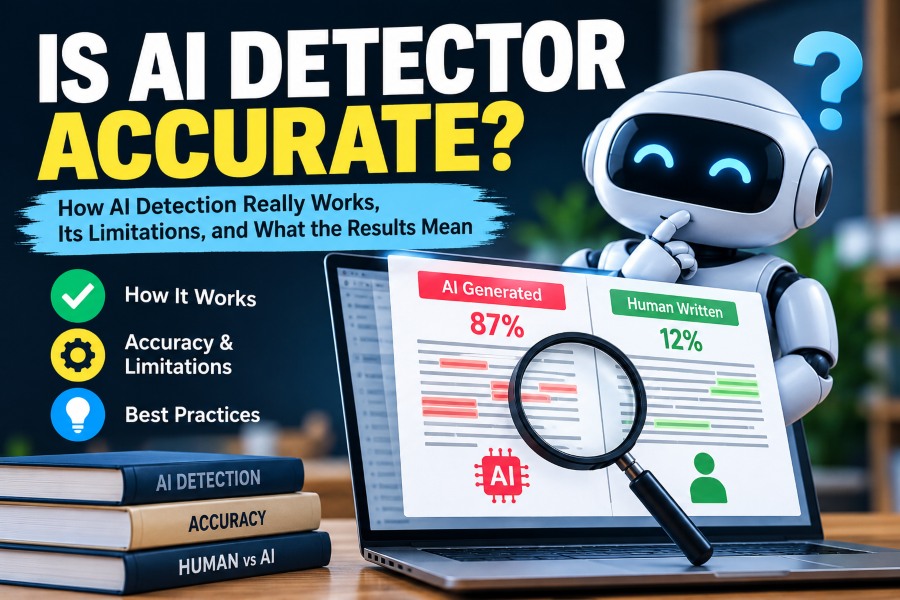
But is AI detector accurate enough to reliably tell whether a piece of text was written by a human or generated by artificial intelligence?
The short answer is not always.
AI detectors can identify patterns that are commonly associated with AI-generated writing, but their results should generally be treated as estimates rather than absolute proof. Human writing can sometimes be classified as AI-generated, while AI-written or heavily edited content can sometimes appear human.
Understanding how these tools work, what affects their results, and what their scores actually mean can help you use an AI detector more responsibly.
What Is an AI Detector?
An AI detector is a software tool designed to estimate whether written content was produced by an artificial intelligence model or a human writer.
Instead of knowing who actually wrote a document, most detectors analyze characteristics of the text and compare them with patterns associated with human and machine-generated writing.
Depending on the tool, an AI detector may examine factors such as:
- Sentence structure
- Word choice
- Predictability
- Repetition
- Writing consistency
- Vocabulary patterns
- Variation in sentence length
- Statistical language patterns
The detector then produces a result indicating how strongly the text resembles AI-generated content.
Some tools display a percentage, while others classify text into categories such as human-written, AI-generated, mixed, or uncertain.
Is AI Detector Accurate?
AI detectors can be useful for identifying patterns associated with machine-generated writing, but they are not perfectly accurate.
The reliability of a detector can vary depending on the detection model, the AI system that generated the content, the length of the sample, the language, the writing style, and whether the text has been edited.
For example, highly structured human writing may sometimes resemble AI-generated text. On the other hand, AI-generated text that has been substantially rewritten by a person may be difficult for a detector to identify.
This creates two important types of errors:
False positive: Human-written content is incorrectly identified as AI-generated.
False negative: AI-generated content is incorrectly identified as human-written.
Because both errors are possible, an AI detection result is better viewed as one signal rather than definitive evidence about authorship.
How Does an AI Detector Work?
To understand AI detector accuracy, it helps to understand what the technology is actually analyzing.
AI detectors typically do not search for a hidden label inside a paragraph saying that it was created by ChatGPT or another AI system. Instead, they evaluate linguistic and statistical characteristics of the text.
1. Text Predictability
Language models generate text by predicting likely words based on the context that comes before them.
As a result, some AI-generated writing can contain highly predictable sequences of words and sentences.
Detection systems may evaluate how statistically expected the language appears. Very predictable text may receive a stronger AI signal.
However, predictability alone cannot establish authorship. Humans can also write simple, conventional, and predictable sentences.
2. Sentence Variation
Human writing often includes natural variation.
A writer may use a short sentence followed by a long explanation. Another paragraph may contain a question, an unusual phrase, or a sudden change in rhythm.
AI-generated content can sometimes be more structurally consistent.
Some detectors therefore analyze variations in sentence length, structure, and complexity.
3. Vocabulary Patterns
AI detection systems may analyze vocabulary distribution and word-choice patterns.
Repeated transitions, unusually consistent terminology, and predictable phrasing can contribute to an AI classification.
Again, these patterns are not exclusive to artificial intelligence.
Formal reports, academic papers, technical documentation, and SEO content can naturally contain repetitive or highly structured language.
4. Statistical Classification
Many detectors use machine-learning models trained on examples of both human-written and AI-generated text.
The system learns patterns associated with each category and then evaluates new content against those patterns.
The final result is therefore a classification or probability estimate rather than direct knowledge of how the document was created.
Why Aren’t AI Detectors 100% Accurate?
The biggest limitation is simple: AI-generated text and human-written text can overlap significantly.
Modern language models are specifically designed to produce natural language. At the same time, humans frequently write in predictable ways.
There is no universal writing pattern that belongs exclusively to either humans or AI.
Several additional factors make detection difficult.
AI Models Continue to Improve
Generative AI systems are constantly evolving.
Newer models can produce more varied sentence structures, adapt to specific writing styles, follow detailed instructions, and create increasingly natural text.
A detector trained primarily on output from older AI models may perform differently when analyzing content produced by newer systems.
This creates an ongoing challenge for detection technology.
Human Editing Changes AI Content
Suppose someone generates an article with AI and then manually rewrites large portions of it.
They may change:
- Sentence structures
- Vocabulary
- Paragraph order
- Examples
- Tone
- Transitions
- Personal observations
After extensive editing, the resulting document may contain characteristics of both human and AI writing.
Determining exactly how much of the final text came from AI becomes much more difficult.
Human Writing Can Look Like AI
Clear and structured human writing can sometimes trigger an AI detector.
Consider a person writing a straightforward explanation using short paragraphs, common vocabulary, and consistent grammar.
Those same characteristics may also appear in AI-generated content.
Therefore, a detector may occasionally classify genuinely human writing incorrectly.
What Is a False Positive in AI Detection?
A false positive occurs when an AI detector labels human-written content as AI-generated.
This is one of the most important limitations to understand.
Imagine a student writes an assignment without generative AI. The writing happens to use consistent sentence structures and predictable academic language.
A detector analyzes the assignment and assigns it a strong AI probability.
That result does not automatically mean the student used AI. It means the detector found patterns that its model associates with AI-generated text.
False positives are particularly important when AI detection is being used in education, publishing, hiring, or other situations where a classification could affect a person.
Detection results should therefore be evaluated alongside other relevant evidence and context.
What Is a False Negative?
A false negative is the opposite problem.
It happens when content generated by AI is classified as human-written.
This may happen when AI content has been heavily edited or when the generated text contains enough linguistic variation to avoid patterns recognized by a particular detector.
Different AI models can also produce different writing characteristics.
Therefore, a low AI score does not prove that no AI technology was involved.
What Does an AI Detection Percentage Mean?
Percentage scores can easily be misunderstood.
If a detector displays 80% AI, users may assume that exactly 80% of the words were generated by artificial intelligence.
That is not necessarily what the score means.
The meaning depends on the specific detection system.
A percentage may represent the model’s confidence, an estimate of how strongly the content resembles AI-generated writing, or the proportion of sentences classified as likely AI.
For that reason, you should read the tool’s documentation before interpreting its score.
An AI detection percentage generally should not be treated as a precise measurement of how much AI was used to create a document.
What Affects AI Detector Accuracy?
Many variables can influence detection results.
Content Length
Very short text provides limited information for analysis.
A detector may have difficulty making a meaningful classification from a single sentence, headline, caption, or short paragraph.
Longer samples generally provide more linguistic patterns to evaluate, although length alone does not guarantee an accurate result.
Writing Style
Formal, repetitive, highly structured, or simplified writing may sometimes resemble patterns associated with AI.
More varied writing may produce different detection results.
Language
Detection performance can differ between languages.
A system trained heavily on English content may not perform equally well with Bangla, Spanish, Arabic, Japanese, or other languages.
Users should therefore check whether a detector officially supports the language being analyzed.
Editing
Manual editing can substantially change the statistical characteristics of AI-generated text.
Similarly, grammar correction, rewriting, translation, or paraphrasing tools may alter detection results.
Type of AI Model
Not every generative model writes in exactly the same way.
Detection performance against one model does not automatically indicate the same performance against another.
Can AI Detectors Detect ChatGPT?
AI detectors may identify patterns associated with text produced by ChatGPT and similar language models, but they cannot always determine with certainty that ChatGPT specifically created a passage.
This distinction matters.
A detector typically evaluates the characteristics of the final text rather than observing the complete writing process.
If a paragraph resembles AI-generated writing, the detector may classify it accordingly. However, similar patterns could potentially come from another AI model or even a human writer.
Likewise, heavily edited AI-generated content may receive a weak AI classification.
Therefore, an AI detector should not be considered a guaranteed method for proving that someone used ChatGPT.
Can AI Detectors Detect Paraphrased AI Content?
Paraphrasing can make detection more difficult because it changes the characteristics detectors analyze.
If AI-generated content is substantially rewritten, its vocabulary, syntax, sentence length, and overall rhythm may change.
However, paraphrasing does not automatically make content undetectable.
Some detectors analyze broader linguistic patterns rather than looking only for particular words or phrases.
Results can therefore vary significantly between tools and texts.
Are AI Detectors Accurate for Student Work?
AI detection in education requires particular caution.
Student writing varies widely according to age, language proficiency, subject, assignment type, and writing experience.
A student may naturally use repetitive sentences or simple vocabulary. Another student may write in a polished and highly structured style.
Neither characteristic proves AI usage.
Teachers and institutions using detection tools should therefore avoid treating a detector score as the sole evidence of academic misconduct.
Other information may provide more context, including:
- Previous writing samples
- Draft history
- Sources and citations
- Revision records
- Assignment-specific knowledge
- The student’s ability to explain the work
AI detection can contribute information, but human review remains important.
Are AI Detectors Accurate for SEO Content?
AI detectors are sometimes used by content marketers and website owners to evaluate articles before publication.
However, AI detection and SEO quality are separate questions.
A detection score does not directly tell you whether content is:
- Helpful
- Accurate
- Original
- Relevant
- Well researched
- Search-intent focused
- Easy to understand
A useful article should primarily be evaluated on its quality and value to readers.
Whether AI contributed to the writing process does not automatically determine whether the final content is useful or poor.
Can Two AI Detectors Give Different Results?
Yes.
The same article can receive different classifications from different AI detection tools.
One detector may identify a passage as likely AI-generated while another may classify it as mostly human-written.
This happens because detection platforms can use different:
- Training datasets
- Classification models
- Thresholds
- Linguistic features
- Scoring systems
Different results do not necessarily mean one tool is malfunctioning. They may simply reflect differences in how the systems evaluate text.
How to Use an AI Detector Properly
An AI detector is most useful when its output is treated as supporting information rather than unquestionable proof.
A practical approach is to:
- Analyze a sufficiently long sample whenever possible.
- Review highlighted sentences or passages rather than focusing only on a percentage.
- Consider the language and type of writing being analyzed.
- Understand how the particular detector defines its scores.
- Consider possible false positives and false negatives.
- Review the broader context surrounding the content.
- Avoid making serious decisions based entirely on one automated score.
This approach provides a more balanced interpretation of detection results.
AI Detection vs Plagiarism Detection
AI detection and plagiarism detection are not the same thing.
A plagiarism checker generally compares submitted content against existing material to identify matching or highly similar text.
An AI detector usually analyzes linguistic patterns to estimate whether the text resembles machine-generated writing.
Therefore, content can be:
- Human-written and plagiarized
- Human-written and original
- AI-generated and original
- AI-generated but similar to existing content
A low plagiarism score does not prove human authorship, and a high AI score does not necessarily indicate plagiarism.
The two technologies address different questions.
Can You Trust an AI Detector?
You can use AI detectors as analytical tools, but you should be cautious about treating their outputs as definitive judgments.
They can be useful for:
- Content review
- Editorial workflows
- Preliminary screening
- Identifying passages for further examination
- Understanding writing patterns
They are less suitable as the only evidence for a high-stakes accusation or decision.
The safest interpretation is usually:
An AI detector provides an estimate based on textual patterns, not absolute proof of authorship.
How Can AI Detection Become More Accurate?
AI detection technology is likely to continue developing alongside generative AI.
Future systems may improve through better training datasets, more sophisticated language analysis, stronger support for different languages, and improved detection of content from newer AI models.
Other approaches may also complement text-based detection.
For example, provenance systems could potentially provide information about where and how digital content was created.
Even with improvements, however, distinguishing human and AI contributions may remain difficult when people and AI systems collaborate closely during the writing process.
Should You Rely on a Single AI Detector?
For important decisions, relying entirely on one automated detector can create unnecessary risk.
Different tools may interpret the same text differently, and each system has its own limitations.
Instead of asking only whether a detector says “AI” or “human,” consider questions such as:
- What exactly does the score represent?
- How much text was analyzed?
- Was the content edited?
- Does the detector support this language?
- Are individual passages being flagged?
- Is there additional evidence about the writing process?
These questions provide much more useful context than a percentage alone.
The Future of AI Content Detection
The relationship between AI generation and AI detection is likely to keep evolving.
As language models become better at producing natural writing, detection tools will need to adapt to new patterns and new forms of human-AI collaboration.
At the same time, the distinction between “AI-written” and “human-written” may become increasingly complicated.
A person might use AI to brainstorm an outline, write the article independently, use another AI system for grammar correction, and then manually rewrite the final draft.
Is that human-written or AI-generated?
The answer depends partly on how AI involvement is defined.
This is why future content verification may focus not only on detecting linguistic patterns but also on understanding content provenance and the writing process.
Final Thoughts: Is AI Detector Accurate?
So, is AI detector accurate?
AI detectors can provide useful estimates about whether text contains patterns commonly associated with AI-generated writing. However, they are not perfectly accurate and should not be treated as definitive proof of who or what created a document.
False positives can classify human writing as AI-generated, while false negatives can allow AI-generated writing to appear human.
Accuracy can also vary based on content length, language, writing style, editing, the AI model involved, and the detector itself.
For everyday content analysis, an AI detector can be a useful additional tool. For education, publishing, hiring, or other high-stakes situations, detection results should be combined with contextual evidence and human review.
Ultimately, the most useful question is not simply “Does this detector say the content is AI?”
It is “What evidence does this result provide, and how confident should we be in that evidence?”
Frequently Asked Questions
Is an AI detector 100% accurate?
No. AI detectors can produce both false positives and false negatives. Their results should generally be interpreted as estimates rather than absolute proof.
Can AI detectors detect ChatGPT accurately?
They may identify patterns associated with ChatGPT-generated text, but they cannot always reliably prove that ChatGPT specifically created a piece of content.
Can AI detectors detect human-written content as AI?
Yes. This is known as a false positive. Structured, predictable, or repetitive human writing can sometimes be incorrectly classified as AI-generated.
Why does my human writing show as AI?
Your writing may contain patterns the detector associates with AI, such as consistent sentence structures, predictable vocabulary, or limited variation. A flagged result alone does not prove that AI was used.
Why do different AI detectors give different scores?
Different tools use different models, datasets, thresholds, and scoring methods. As a result, the same content can receive different classifications across detection platforms.
Does a 90% AI score mean 90% of the article was written by AI?
Not necessarily. The meaning of percentages varies between tools. It may represent confidence, detected patterns, or classified sections rather than the exact percentage of words generated by AI.
Are AI detectors accurate for essays?
They can provide an additional signal when reviewing essays, but their results should not be used alone to determine whether a student used AI.
Can AI detectors detect edited AI content?
Sometimes. Extensive human editing can change the linguistic patterns of AI-generated content and may make detection more difficult.
Is AI detection the same as plagiarism detection?
No. AI detection estimates whether writing resembles machine-generated content, while plagiarism detection searches for similarities between submitted text and existing sources.
Should I trust an AI detector result?
Treat the result as one piece of information. For important decisions, combine it with human review, context, writing history, and other relevant evidence.

Comments
0 responsesNo comments yet. Be the first to share your thoughts.